Experts in Compensation Plan Design
We are committed to providing the best compensation design services, custom and industry surveys, and implementation support to companies who want to strategically align compensation with organizational goals.
Experts in Compensation Plan Design
We are committed to providing the best compensation design services, custom and industry surveys, and implementation support to companies who want to strategically align compensation with organizational goals.

A few days later, she came back with a draft plan that she asked me to review, and to let her know if there were any problems that I saw with it. A quick perusal made it evident that she’d plugged her notes from our conversation into an AI program and had copied out what it told her to do and sent that to me. I’ve no doubt this is just the first in what will be many such interactions with clients. I don’t blame her for doing this, and I was curious what result the AI would give her. We all know (by now) that this burgeoning technology can be simultaneously very confident and very wrong. The recommendation it gave wasn’t so much wrong, as it was just…off. Plan weights were assigned to modifiers and the approach was not something that could have been administered (for example, it suggested taking a deduction for negative loads after the first 2 in a month – loads change value all the time!), and it said that all GM$ from negative loads should not be included in the GM% calculation which would only have the effect of artificially INFLATING the GM%.
After Covid, salaries increased quickly in nearly every industry. While 3% merit increase or COLA budgets had been the norm for what seemed like decades, suddenly salary jumps were in double digits. I’m sure you all remember the most common carrier sales rep salary quoted prior to Covid…” $36,000” – easily divisible by 12. We are 25% higher than that now, with some places reporting even higher values.
Without reliable compensation survey data, companies are left guessing or relying on hearsay from employees who have a vested interest in finding numbers as high as possible.
Good survey data relies on validated incumbent-level data (not self-reported “averages”) and provides objective insight into:
Market salary ranges for comparable roles
Typical pay mix between salary and incentives
Total target compensation levels across the industry
Geographic differences
The ability to do custom cuts based on defined peers (usually for an additional fee)
This information allows leaders to determine whether they are truly below market—or simply experiencing normal competitive pressure.
I’ve developed incentive compensation plans for more than 500 companies over the last 27 years. It always has interested me how some companies get far better results from the changed compensation plans than others, especially when using similar compensation approaches. Companies, like people, have particular personalities, and, also like people, they can get in their own way. Changing a compensation plan will not automatically change other aspects of a company that may be hindering their success. Conversely, a company who already manifests successful characteristics is much more likely to experience the full benefit of a new compensation plan.
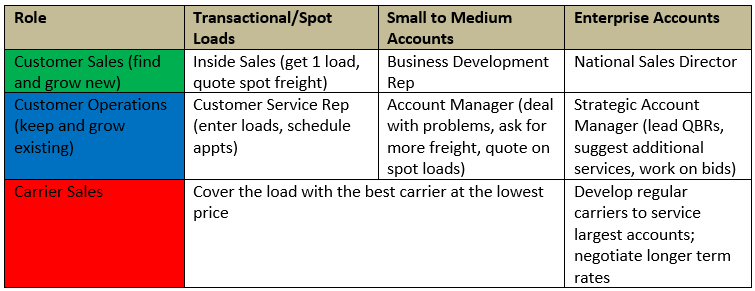
In the previous article we looked at the Cradle to Grave organization structure and the common compensation approaches used to go along with those roles. Now we will look at the Split Model, the roles commonly found in this model, and how they should be paid (spoiler…paying everyone a commission (% of the load), while common, is suboptimal).
I’ve been working with freight brokers for over 15 years now, helping them revise their organization structure and align their compensation plans to support the goals of their business. While the number of different possible organization structures is almost limitless, there are really only two approaches, with some variations on each: Cradle to Grave and Split Structure. This article deals with the first; we will address the Split Structure in the next article.
We’ve been working our way through the various ways you can calculate incentive pay and have covered quite a few so far. As a recap, here are the various methods and the articles you can reference to find the content on that method.
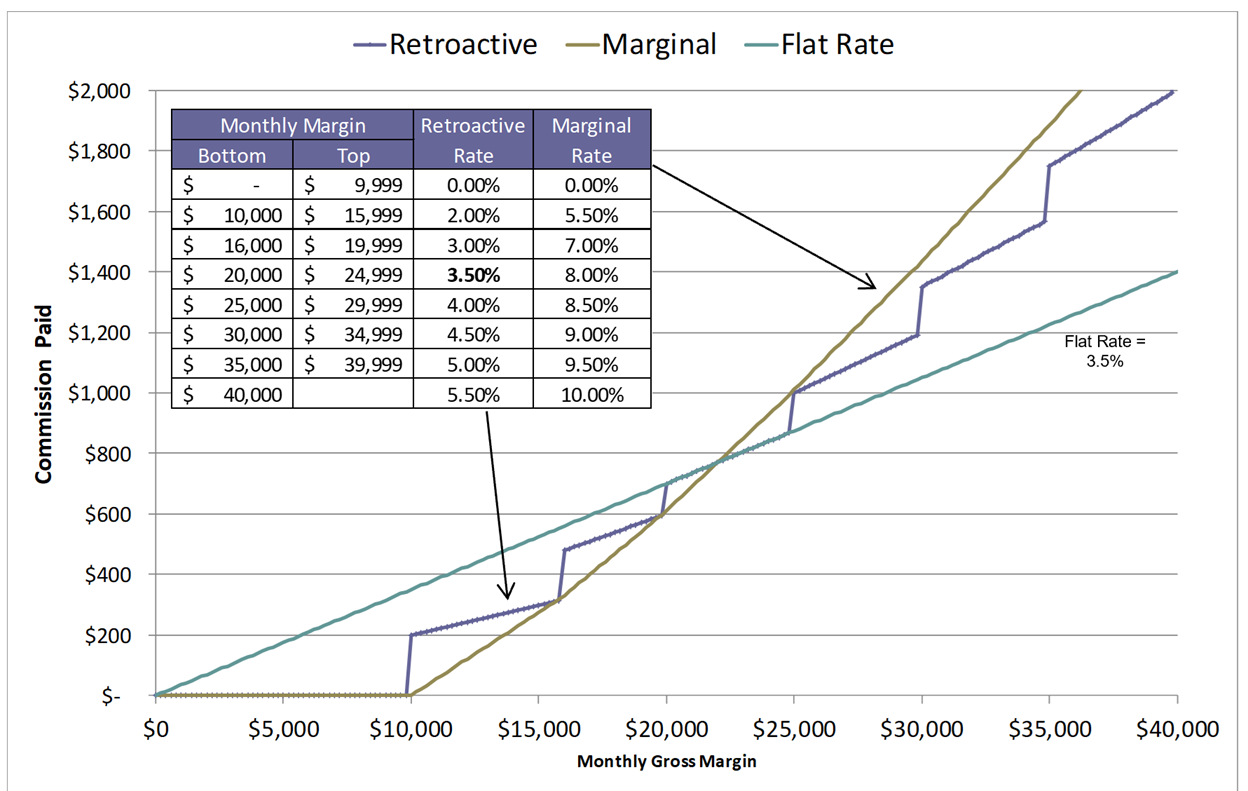
A better approach, though I admit it’s harder to explain, is the progressive rate. This pays the higher commission rate only on the dollars within the tier…NOT back to previous tiers or the first dollar. This allows you to get a much smoother payout curve so there is now very little reason to cheat the plan.
On the commission side of our graph (see the article from September 2023), we are moving toward using some sort of “goal” to affect payout, rather than simply paying a straight commission from the first dollar. One of the ways companies initially think of doing this is by deducting the salary or a “seat cost” from the commission calculation. This ensures that commissions are not paid until the employee as covered their costs to the organization, which is usually an approach that CFO’s like… a lot. And it can have it’s place in an organization, particularly when it is just starting up. However, it does have some downsides.
In previous articles we looked at different organization structure such as Cradle to Grave or Split model organizations and I referenced the need to understand different compensation approaches when dealing with split roles so that you can do something OTHER than simply paying everyone a smaller and smaller percentage of the GM$. This article will be the first in a series that will go into detail on these different approaches and how you can learn to select the best one for your various roles.
In this webinar, Beth previews key topics covered for her upcoming training and answers questions from the audience. Learn more strategies to recruit and retain top talent and how to shape your organizational structure to fit your compensation needs.